Also popular on Telescope Advisor
Buying Guide · 2026 Edition
Best Telescopes for Beginners in 2026 12 Models Compared by Real Use Case
The Celestron AstroMaster 70AZ takes the Telescope Advisor Award for Best Beginner Telescope 2026. This guide ranks 12 beginner telescopes by aperture, mount ease, and first-night results so you spend clear nights observing, not troubleshooting.
Choosing your first telescope is one of the most exciting — and most confusing — decisions a new astronomy enthusiast faces. The market is flooded with scopes that promise extraordinary views but deliver frustration. This guide cuts through the noise with hands-on evaluations of 12 telescopes across every budget and skill level. We awarded the Celestron AstroMaster 70AZ the Best Beginner Telescope 2026 title after evaluating ease of setup, optical quality, mount stability, and real first-night performance. Whether you want to track down Saturn's rings tonight or image the Andromeda Galaxy next month, there is a right scope for you below.
Want a shortlist instead of more theory?
Tell us your budget, targets, and experience level — the Finder Tool narrows the field to the models that actually fit your use case.
| Model | Aperture | Best For | Score | Buy |
|---|---|---|---|---|
| Celestron AstroMaster 70AZ Award Winner | 70mm | Best overall — easiest setup, planet views | 9.3/10 | Amazon |
| Sky-Watcher Heritage 130P | 130mm | Best deep-sky on a budget | 9.1/10 | Amazon |
| Celestron StarSense Explorer DX 130AZ | 130mm | Best smartphone-guided beginner scope | 9.0/10 | Amazon |
| Gskyer 70mm AZ Refractor | 70mm | Best under $100 | 8.1/10 | Amazon |
Full 12-model comparison with scores below.
Not sure which telescope is right for you?
Answer 4 quick questions about your budget, goals, and experience level — our Telescope Finder Tool recommends the exact model for your needs.
Quick Answer: Best Beginner Telescope in 2026
The Celestron AstroMaster 70AZ is the best beginner telescope in 2026 for most new astronomers. Its 70mm aperture shows the Moon's craters in crisp detail, reveals Jupiter's cloud bands and four Galilean moons, and displays Saturn's rings — all within the first clear night. The alt-azimuth mount points up-down and left-right naturally, without the polar alignment complexity that frustrates beginners on equatorial mounts. Setup takes under 10 minutes and no collimation is ever required.
Best overall beginner telescope
Celestron AstroMaster 70AZ — 70mm refractor, alt-az mount, setup under 10 minutes. Ideal for reliable first-night views of planets and the Moon.
Best beginner telescope for deep-sky
Sky-Watcher Heritage 130P — 130mm tabletop Dobsonian with exceptional light gathering. Shows star clusters and nebulae with striking detail. How many stars will you actually see? →
Best beginner smart telescope
ZWO Seestar S50 — app-driven auto-slew and live stacking. Finds and photographs objects automatically for anyone who wants technology to do the work.
Best budget beginner telescope
Gskyer 70mm AZ Refractor — honest optics and a portable kit under $100. A solid first step for anyone uncertain about committing to the hobby.
Quick Picks by Budget (2026)
Under $100: Gskyer 70mm AZ
Under $200: AstroMaster 70AZ
$200–$400: Heritage 130P
$400+: StarSense DX 130AZ
Next Best Step
Most beginners do best with one of these next steps
If you still feel unsure, move sideways into a recommendation flow or a tighter beginner comparison before you buy anything.
Beginner Buying Mistakes That Cause Most Regret
Most poor first-telescope experiences come from avoidable purchase mistakes, not from astronomy being difficult. Use this checklist before checkout.
Mistake 1: Buying by magnification claims
Ignore 600x/700x marketing. Aperture and mount stability matter far more for real detail.
Mistake 2: Picking a hard first mount
Many beginners do better with alt-az or Dobsonian systems than entry equatorial mounts.
Mistake 3: No budget split for accessories
Reserve budget for one useful eyepiece upgrade and comfort items so sessions are repeatable.
Mistake 4: Mismatch with your observing style
If you need quick weeknight sessions, favor simpler setups over larger but high-friction rigs.
What Beginners Actually Want to See
Every beginner has the same wish list. Here is exactly what the top targets look like through a beginner telescope, what aperture is needed, and which pick delivers it most reliably on the first night.
The Moon
Tycho crater rays, Copernicus basin walls, and the terminator where sunrise casts deep shadows across crater floors. Stunning in any scope at any magnification. A quarter or gibbous Moon is better than full — shadows add drama.
Min scope: Any · Ideal pick: AstroMaster 70AZ
Saturn’s Rings
The ring halo appears at 50x in a 60mm+ scope, clearly detached from the globe. With 100mm+ at 150x on a steady night, the Cassini Division appears as a fine dark line. In 2026 the rings are tilted at 7.5° after the 2025 edge-on phase — a great year to observe.
Min scope: 60mm at 50x+ · Ideal pick: Heritage 130P
Jupiter & Its Moons
At 80x, Jupiter shows two dark equatorial cloud belts and all four Galilean moons in a line. Night to night the moons shift position — a live model of the solar system in motion. Visible for much of the year, easily one of the most satisfying beginner targets.
Min scope: 50mm at 50x+ · Ideal pick: AstroMaster 70AZ
Star Clusters
The Pleiades sparkle with dozens of blue-white stars in one wide-field view. The Double Cluster in Perseus and the Beehive (M44) are easy winter and spring targets. Visible even from suburban skies — no dark site required. A favourite for any scope on any night.
Min scope: Any · Ideal pick: Heritage 130P (widest field)
Orion Nebula (M42)
A glowing winged gas cloud visible from suburban skies in any scope. Through a 70mm at 40x, the Trapezium cluster at its core resolves into 4 hot young stars surrounded by nebulosity. The brightest nebula in the sky — best in winter and spring.
Min scope: 50mm at 30x+ · Ideal pick: Heritage 130P
Mars & Other Planets
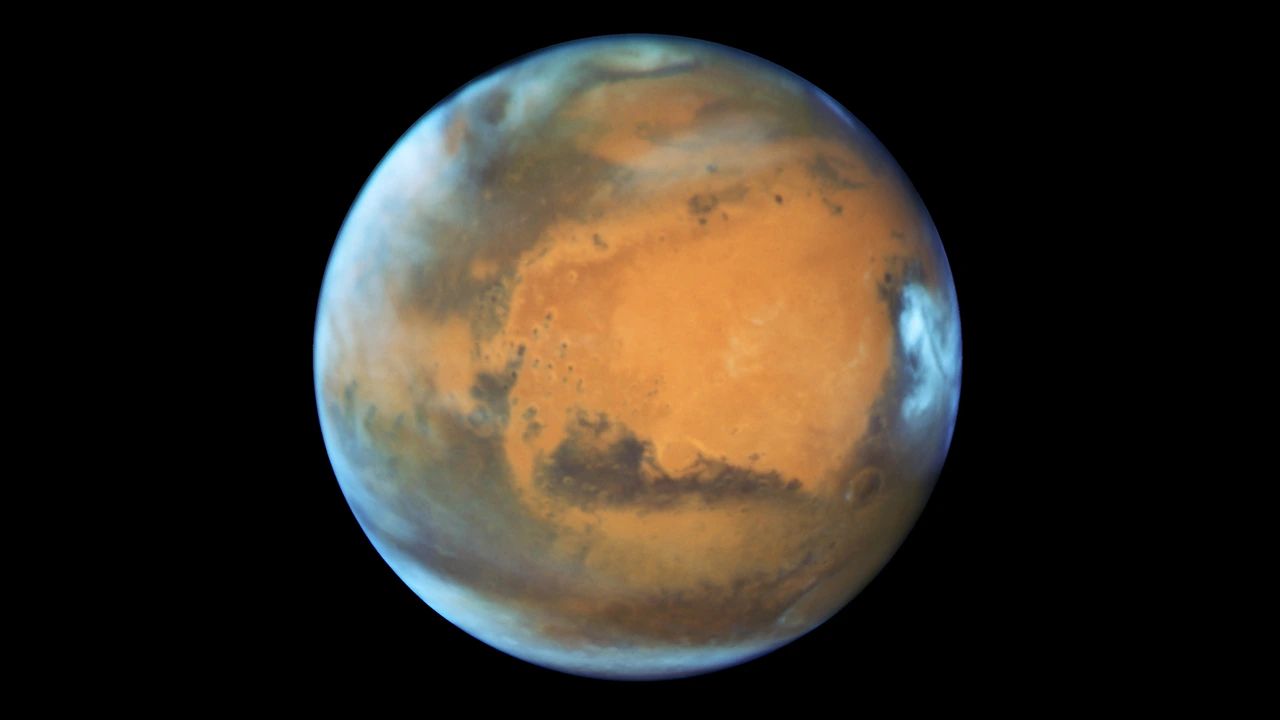
At opposition Mars shows as an orange disk through 80mm+ at 100x — the polar ice cap and dark markings Syrtis Major and Hellas are visible in good seeing. Venus shows distinct phases. Next good Mars opposition: January 2027.
Min scope: 80mm at 100x+ at opposition · Ideal pick: Inspire 80AZ
Celestron AstroMaster 70AZ
Refractor · 70mm aperture · 900mm focal length · f/12.9 · Alt-azimuth mount · Full review →
The Celestron AstroMaster 70AZ takes the crown for best beginner telescope in 2026. With its 70mm aperture and user-friendly design, it provides clear views of the Moon, planets, and bright deep-sky objects. The alt-azimuth mount makes it easy to navigate the night sky, while the included accessories — two eyepieces and a finderscope — help beginners get started immediately without buying extras.
What sets this telescope apart is its combination of quality optics, sturdy construction, and intuitive operation. Beginners can achieve impressive results without the steep learning curve of more complex telescopes. The refractor design means collimation is never needed, and the fully coated glass optics produce sharp, high-contrast images even in suburban skies.
Optical Specs
Aperture: 70mm
Focal Length: 900mm (f/12.9)
Design: Achromatic refractor
Mount and Setup
Mount: Alt-Azimuth
Tripod: Adjustable aluminum
Setup time: Under 10 minutes
What You Will See
Moon craters, Jupiter cloud bands
Saturn rings, Mars disk
Bright clusters, Orion Nebula
Beginner Telescope Comparison Table 2026
All affiliate links sourced from confirmed in-stock products. Scores based on aperture, mount ease, setup time, and first-night results.
| Model | Type | Aperture | Best For | Score | Link |
|---|---|---|---|---|---|
| Celestron AstroMaster 70AZ | Refractor | 70mm | Overall best beginner | 9.3/10 Award Winner | Amazon |
| Sky-Watcher Heritage 130P | Tabletop Dobsonian | 130mm | Deep-sky on a budget | 9.1/10 | Amazon |
| Celestron StarSense Explorer DX 130AZ | Reflector | 130mm | Smartphone-assisted GoTo | 9.0/10 | Amazon |
| Celestron Astro Fi 102 | Refractor (WiFi GoTo) | 102mm | App-connected smart scope | 8.8/10 | Amazon |
| Celestron Inspire 80AZ | Refractor | 80mm | Planet viewing starter | 8.6/10 | Amazon |
| Celestron AstroMaster 130EQ | Reflector (EQ mount) | 130mm | Learning equatorial tracking | 8.4/10 | Amazon |
| ZWO Seestar S50 | Smart Telescope | 50mm sensor | Auto-imaging, zero effort | 8.4/10 | Amazon |
| Celestron NexStar 4SE | Compound (GoTo) | 102mm | Computerized object finding | 8.3/10 | Amazon |
| Gskyer 70mm AZ Refractor | Refractor | 70mm | Budget starter under $100 | 8.1/10 | Amazon |
| National Geographic 90mm Refractor | Refractor | 90mm | Family and kids | 8.0/10 | Amazon |
| Celestron FirstScope 76 | Tabletop Dobsonian | 76mm | Kids and quick sessions | 7.9/10 | Amazon |
| Sky-Watcher Startravel 80 | Refractor | 80mm | Wide-field and portable | 7.8/10 | Amazon |
Setup Difficulty Compared — Top 7 Beginner Picks
The single biggest factor in first-night satisfaction is not aperture — it is whether the telescope is actually usable without frustration. Here are the top 7 picks rated by ease of first use.
| Telescope | Aperture | Mount Type | Setup Time | Setup Difficulty | Best For |
|---|---|---|---|---|---|
| Celestron AstroMaster 70AZ ⭐ | 70mm | Alt-Az | <10 min | Very Easy | Best first scope overall |
| Gskyer 70mm AZ Refractor | 70mm | Alt-Az | <10 min | Very Easy | Budget pick under $100 |
| Celestron Inspire 80AZ | 80mm | Alt-Az | <10 min | Very Easy | Planets & gifts |
| Sky-Watcher Heritage 130P | 130mm | Tabletop Dobsonian | 10–15 min | Easy* | Deep-sky + planets, best value |
| Celestron StarSense Explorer DX 130AZ | 130mm | Alt-Az + App | 10–15 min | Moderate* | App-guided object finding |
| Celestron NexStar 4SE | 102mm | GoTo Alt-Az (motorized) | 15–20 min | Moderate | Motorized GoTo, no star-hopping |
| Celestron AstroMaster 130EQ | 130mm | Equatorial | 20–30 min | Advanced | Learning EQ tracking |
* Heritage 130P requires a table or raised surface (not included). StarSense DX requires smartphone pairing on first use (one-time, ~5 minutes).
Best Beginner Telescopes in 2026
Celestron AstroMaster 70AZ
Refractor — 70mm — 900mm focal length — f/12.9 — Alt-Az mount
The AstroMaster 70AZ is the easiest telescope to recommend for any first-time buyer in 2026. The 70mm refractor gives genuinely sharp views of the Moon, Saturn rings, Jupiter cloud bands, and the Orion Nebula. The alt-azimuth mount points intuitively with no polar alignment ritual. The tripod is stable for the aperture class, and both included eyepieces (10mm and 20mm) are optically honest. There is no collimation, no firmware, and no batteries required for basic use.
Strengths
- No collimation ever needed (refractor design)
- Ready to observe in under 10 minutes
- Fully coated optics — sharp, high contrast
- Two eyepieces plus finderscope included
- Stable enough for 150x magnification
Limitations
- 70mm limits faint deep-sky performance
- No motorized tracking
- Manual slow-motion controls take practice
Sky-Watcher Heritage 130P
Reflector — 130mm — 650mm focal length — f/5 — Tabletop Dobsonian
The Heritage 130P is a 130mm parabolic Newtonian on a tabletop Dobsonian base. It punches well above its price in light-gathering ability. At f/5 it is a wide-field scope that makes the Pleiades, open clusters, and the Leo Triplet galaxies look spectacular. The collapsible tube keeps storage easy. The only trade-off is that you need to place it on a table or sturdy surface, and occasional collimation checks are needed — a learnable 5-minute job. Read our full Heritage 130P review →
Strengths
- 130mm aperture — exceptional for the price
- Parabolic mirror — sharp edge-to-edge stars
- Collapsible tube for easy storage
- Outstanding on clusters and nebulae
Limitations
- Requires a table or solid surface
- Collimation needed after transport
- No tripod included
Celestron StarSense Explorer DX 130AZ
Reflector — 130mm — Smartphone star-finding mount
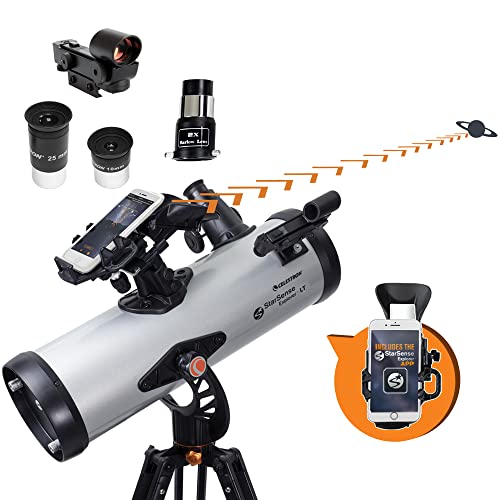
The StarSense Explorer uses your smartphone camera and the Celestron app to analyze star patterns and tell you exactly which direction to nudge the telescope to reach any of 120,000+ objects. There is no GoTo motor, no polar alignment, and no star chart knowledge required. This makes it ideal for beginners who want guided observing without the full GoTo price tag. The 130mm aperture gives more light-gathering than the 70mm AstroMaster.
Celestron Astro Fi 102
Refractor — 102mm — WiFi GoTo mount
The Astro Fi 102 connects to your smartphone via WiFi and uses the Celestron SkyPortal app for fully computerized GoTo operation without a hand controller. The 102mm refractor aperture gives noticeably better planetary detail than a 70mm, and the GoTo mount makes finding faint objects painless. It removes essentially all frustration around pointing the telescope for absolute beginners.
ZWO Seestar S50
Smart Telescope — 50mm aperture — Built-in camera — Auto live-stacking
The ZWO Seestar S50 is a complete smart imaging station. Point it at a sky area, tell the app what you want, and within minutes it autonomously tracks and live-stacks the target. Nebulae, galaxies, and clusters gradually reveal themselves on your phone in real color. The built-in cooled sensor and auto-stacking produce results that a traditional 130mm scope cannot match for astrophotography beginners. It also works well under moderate light pollution, making it ideal for suburban observers.
Honorable Mentions
Gskyer 70mm AZ Refractor
Excellent value and portability — the best option under $100 for anyone testing the hobby before committing to a higher-end model. Honest optics, compact kit, good starter eyepieces.
Check price on Amazon →National Geographic 90mm Refractor
A family-oriented 90mm refractor with a recognized brand. The extra 20mm over a 70mm gives a meaningful brightness improvement on planets and the Moon — a great gift choice.
Check price on Amazon →Celestron Inspire 80AZ
An 80mm refractor with a built-in phone adapter and red-dot finder. The dedicated planet viewing design makes Saturn rings pop on the first night. A good upgrade from 70mm without adding complexity.
Check price on Amazon →Celestron FirstScope 76
A compact tabletop Dobsonian with great portability. Perfect for kids and quick backyard sessions. The intuitive push-and-look Dobsonian motion is the fastest way to get a beginner observing without frustration.
Check price on Amazon →Celestron NexStar 4SE
A fully computerized GoTo compound telescope on a single-arm mount. The 102mm Maksutov-Cassegrain design gives sharp, high-contrast planetary views. Ideal for beginners who want push-button object finding from night one.
Check price on Amazon →Celestron AstroMaster 130EQ
A 130mm Newtonian on an equatorial mount — the largest aperture in the beginner EQ range. The equatorial mount teaches polar alignment fundamentals. Recommended for beginners who plan to advance toward astrophotography.
Check price on Amazon →What You'll Actually See: Aperture vs. Object Guide
Aperture (the diameter of the main mirror or lens) is the single biggest factor determining what you can see. More magnification without more aperture only enlarges the blur — never the detail. For the full physics, see Aperture vs Magnification explained →. Use this table to match your expectations with reality before you buy.
| Aperture | Moon & Sun | Planets | Deep-Sky Objects | Best For |
|---|---|---|---|---|
| 60–70mm | Craters, maria, sharp limb detail | Saturn rings, Jupiter bands, Venus phases | Pleiades, Orion Nebula (fuzzy patch), some open clusters | Beginners, kids, travel |
| 80–90mm | Rilles, mountain ranges, terminator detail | Cassini Division in Saturn rings, Jupiter GRS, Mars polar cap | M42 Nebula structure, Andromeda Galaxy glow, globular clusters | Suburban skies, casual stargazers |
| 100–114mm | Fine crater detail, domes, wrinkle ridges | Saturn moons, Jupiter cloud belt detail, Uranus disc | Spiral structure hints in M31, Ring Nebula (smoke ring), Hercules Cluster resolved | All-round use, first “serious” scope |
| 130–150mm | Boulder-scale craters, complex rilles | Saturn Encke Gap, Jupiter festoons, Neptune as blue-grey disc | Andromeda dust lanes, Whirlpool Galaxy, many faint nebulae, galaxy pairs | Dark-sky observers, serious hobbyists |
| 200mm+ | Exceptional detail at high power | Saturn storm activity, Jupiter satellite shadows in transit | Globular cluster resolution, faint galaxy clusters, planetary nebulae structure | Experienced observers, dark sites |
* Results depend on sky darkness, atmospheric seeing, and eyepiece quality. Urban skies reduce deep-sky performance by 1–2 aperture rows.
How to Choose a Beginner Telescope: The PACE Method
Before buying any telescope, work through these four factors. Each one narrows your choice significantly.
P — Purpose
Decide what you want to observe in your first six months. Planets and the Moon: any quality refractor 70mm or larger works. Deep-sky objects (galaxies, nebulae): you need 100mm or more aperture and dark skies. Everything: a 130mm Newtonian on an alt-az mount handles both. Purpose drives every other decision.
A — Aperture
For beginners, the confidence zone is 70mm to 130mm. A 70mm refractor shows Saturn rings and Jupiter moons clearly. A 130mm reflector adds faint nebulae and galaxies to the list. Avoid claims of 700x magnification on cheap scopes — usable magnification is limited by aperture, not the eyepiece.
C — Comfort
A telescope that is awkward to carry gets ignored. Check total weight, tripod height range, and setup time. The best telescope is the one you actually use on a weeknight. If you live in an apartment, a portable tabletop scope beats a full-size instrument you can't move easily. Note: don’t try to observe through a closed window — open it or use the balcony.
E — Effort
Measure total effort: assembly time, finder alignment, and polar alignment. Alt-azimuth mounts (AstroMaster 70AZ, Heritage 130P) require zero alignment. Equatorial mounts require polar alignment — valuable to learn, but adds 15 minutes to setup. GoTo mounts need a 3-star alignment each session.
The Most Common Beginner Mistake: Prioritizing Aperture Over Mount
Most beginners over-prioritize aperture and under-prioritize mount stability. A wobbly tripod makes a 130mm scope deliver worse results than a stable 70mm. Always buy the best mount you can afford — the optics are secondary to a rock-solid, intuitive mounting system. This is exactly why the AstroMaster 70AZ wins the 2026 award: the tripod and mount are class-leading for a starter price.
First Night Setup Checklist
Follow this sequence on your first observing session to avoid the most common beginner frustrations:
Before Dark (10 to 15 minutes)
- Assemble the telescope and tripod in daylight
- Align the finderscope on a distant land target such as a rooftop or tree
- Insert the lowest-power eyepiece (20mm or 25mm)
- Let the telescope cool to outdoor temperature for 30 minutes
Your First Targets (in order)
- The Moon — a quarter or gibbous Moon is best; full Moon is too bright
- Jupiter — find the cloud bands and four Galilean moons
- Saturn — rings visible at 50x on any quality scope
- Orion Nebula (M42) — best winter and spring deep-sky target
- The Pleiades — dazzling open cluster even in suburban skies
Need the full walkthrough? See our how to set up a telescope for beginners guide. Also common on the first night: why does my telescope show everything upside down? — it’s completely normal.
Continue Exploring
Most new observers take one of these next steps
Stay in research mode for one more click before you buy, or move straight into a recommendation flow.
Next Buying Steps After Your First Shortlist
- If city skyglow is your main constraint, compare light-pollution telescope picks.
- If your first choice is between automation and manual skill, use this GoTo vs manual framework.
- If apartment logistics matter most, shortlist from balcony-friendly options.
- If you want to avoid first-night frustration, run this setup guide.
Related Guides
Best Aperture for Beginners
Choose 70mm, 114mm, 130mm, 6-inch, or 8-inch with a practical first-year framework.
Night Sky This Month
A beginner-friendly monthly target list with what to observe first tonight.
Best Portable Telescopes for Travel
Travel-first picks ranked by carry profile, setup speed, and real field use.
Best Manual Telescopes for Beginners
Learn the sky with low-friction manual picks and a practical learning path.
Best Tabletop Dobsonian 2026
Heritage 130P, 150P, and Virtuoso GTi — the best compact Dobs for beginners.
How Much Does a Telescope Cost?
Complete price guide — 5 budget tiers, what you get at each, and what to avoid.
Best Astrophotography Telescopes
Ready to graduate from visual to imaging?
Best Telescope for Deep Space
Aperture-first picks for galaxies, nebulae, and star clusters.
Best Telescope for Deep-Sky Beginners
A detailed beginner roadmap for first galaxies, nebulae, and cluster sessions.
Best Telescopes Under $300
Tight budget? These are the honest choices.
Best Telescopes for Planets
Jupiter, Saturn, and Mars — maximizing detail.
Best Telescope for Planets Only
Only interested in planets? This focused list keeps your first purchase simple.
Celestron PowerSeeker 127EQ Review
Before buying a 127EQ bundle, read the mount and value tradeoffs first.
Sky-Watcher Skyliner 200P Review
See why an 8-inch Dobsonian remains the visual value benchmark.
Best Telescope for Seniors
Comfort-first picks with low-strain setup and easier controls.
Best Telescope for Astrophotography Beginners
Easy starter imaging setups with beginner camera pairings.
Telescope Advisor Awards 2026
See all 8 category winners for 2026.
How to Set Up a Telescope
Step-by-step first night guide.
7 Telescope Buying Mistakes
Max magnification hype, wrong mount, ignoring aperture — and how to avoid every trap.
Perseid Meteor Shower 2026
The year's most popular shower peaks Aug 11–12 — a perfect first meteor event for beginners.
Blue Moon May 31, 2026
Blue Moon + Micromoon — what craters and ray systems to look for, which magnification to use, and why you need a Moon filter.
Lunar Eclipse 2026: Exact US Times
Get the exact ET, CT, MT, and PT timing plus best beginner setup for eclipse night.
Venus-Jupiter Conjunction June 2026
Where to look after sunset and which binoculars keep both planets in one view.
Best Telescope Brands Compared
Celestron vs Sky-Watcher vs Explore Scientific — which brand wins?
Best Telescopes for Adults 2026
Performance-first picks for adult buyers who want to skip toy-grade kits.
Celestron vs Sky-Watcher vs Orion
Brand score matrix — which manufacturer is right for your budget and goals?
Stargazing for Beginners
Complete beginner's guide — naked eye to binoculars to your first telescope.
Best Astronomy Apps 2026
SkySafari, Stellarium, ISS Detector and more — reviewed for iOS and Android.
Best Dobsonian Telescopes 2026
Maximum aperture for the money — the best Dobs for visual deep-sky observing.
Telescope Troubleshooting: 12 Causes & Fixes
Can't see anything? Fix dust caps, focus, collimation, and 9 more common causes in minutes.
Best Telescope Gift for a Beginner 2026
Buying for someone else? 7 picks by budget tier and recipient profile — with age guidance.
Does Light Pollution Ruin Telescope Viewing?
The honest answer for city and suburban observers — what you can still see and how to maximize every session.
Best Telescope for Light Pollution (2026)
9 ranked city-proven picks for urban and suburban skies, from GoTo to smart scopes.
Best Reflector Telescopes for Beginners
Beginner-safe reflector picks ranked by learning curve and aperture value.
Best Telescopes for Urban Stargazing
City-first recommendations for balconies, rooftops, and short weeknight sessions.
Gskyer Telescope: How to Use It Correctly
Beginner-safe setup and first-night workflow that avoids common startup mistakes.
Telescope Near Me Buying Guide
Local-store decision checklist plus smart same-day alternatives for first-time buyers.
Frequently Asked Questions
What is the best telescope for beginners in 2026?
The Celestron AstroMaster 70AZ wins the Telescope Advisor Best Beginner Telescope Award for 2026. It combines a 70mm aperture, user-friendly alt-azimuth mount, under-10-minute setup, and clear first-night views of the Moon, Saturn, and Jupiter. No collimation is needed and the included accessories are genuinely useful.
How much should I spend on my first telescope?
For a quality experience on the first night, plan on spending $150 to $350. Below $100, optics quality drops significantly. Above $400, you gain GoTo motors or larger aperture — useful but not essential for beginners. The Celestron AstroMaster 70AZ sits squarely in the sweet spot around $150 to $200.
Can I see Saturn's rings with a beginner telescope?
Yes. Saturn's rings are visible through any quality 60mm or larger telescope at magnifications above 50x. The Celestron AstroMaster 70AZ shows the rings and the Cassini Division clearly at 90x. In 2026 Saturn's rings are at a tilted angle before returning toward edge-on — making this a great year to observe them.
What is the difference between a reflector and refractor for beginners?
A refractor uses glass lenses, never needs collimation, and is the lowest maintenance option — ideal for true beginners. A reflector uses mirrors, delivers more aperture per dollar, but requires occasional collimation. For most beginners, a refractor is the better starting point. See our full reflector vs refractor guide for a detailed comparison.
Is a GoTo mount worth it for a beginner?
A GoTo mount automatically finds and tracks objects using motors and a star database. For beginners who want to observe without learning star-hopping, it removes significant frustration. The best compromise is the Celestron StarSense Explorer DX 130AZ, which uses your phone to guide you to any target without motorization or the associated price premium.
Can a beginner telescope see galaxies?
Yes, with realistic expectations. The Andromeda Galaxy (M31) is visible as a fuzzy glow in even a 50mm binocular. With a 130mm telescope under dark skies, you can see the core and structure of brighter galaxies. The Leo Triplet and Virgo Cluster are within reach of a 130mm scope on dark nights. A 70mm will show the brightest galaxies as faint glowing patches — inspiring enough for a first session.
What is the best beginner telescope for adults in 2026?
For adult beginners specifically, the Sky-Watcher Heritage 130P (130 mm tabletop Dobsonian) and the Celestron StarSense Explorer DX 130AZ are both stronger choices than entry refractors. Adults generally benefit from larger aperture (more detail on planets, more deep-sky objects visible) and a more substantial mount. Both deliver striking views of Saturn, Jupiter, the Moon, M13, M31 and the Orion Nebula on the very first night, and both are simple enough that no astronomy background is required.
What is the best beginner telescope under $300?
Under $300, our 2026 top pick is the Sky-Watcher Heritage 130P (around $230–$280) for the most aperture per dollar in the category. Runner-up at this price is the Celestron AstroMaster 70AZ (around $150–$200) which is the easiest setup and a perfect first refractor. See our dedicated best telescopes under $300 guide for the full comparison and live prices. Strictly at $200? Our 7 best telescopes under $200 guide tests and ranks the top budget picks with pros, cons, and live prices.
What is the best beginner telescope for moon and planets in 2026?
For lunar and planetary detail (Saturn's rings, Jupiter's bands, Mars surface markings), the Celestron AstroMaster 102AZ (4-inch refractor) and the Celestron NexStar 4SE deliver the best results in the beginner price range. Refractors with longer focal lengths excel on planets because they handle high magnification (150×–200×) cleanly. See our best telescope for viewing planets guide for in-depth picks.
What is the best entry-level telescope for someone with no experience?
If you have zero experience and want the lowest possible learning curve, the Celestron AstroMaster 70AZ remains our top entry-level pick: an alt-azimuth mount that points like a camera tripod, a finderscope to locate targets, and no collimation or motors to learn. You can be observing the Moon and Saturn within 10 minutes of unboxing.
What mistakes do beginners make when buying a first telescope?
The four most common beginner mistakes are: (1) Buying based on magnification claims — cheap scopes advertise 700x, but usable magnification is limited by aperture. A quality 70mm scope delivers 140x maximum. (2) Choosing an equatorial mount without researching polar alignment — the added complexity ruins first nights. (3) Expecting Hubble-quality images — a telescope shows real-time photon views, not processed images. Saturn’s rings are real and beautiful but subtle. (4) Skipping thermal cool-down — a scope taken from warm indoors to cold outdoors needs 20–30 minutes to stabilise before views are sharp. Knowing these pitfalls in advance makes the first night a success instead of a disappointment. See exact cool-down times by scope type →
Part of Our 2026 Series
See our complete 2026 roundup: Best Telescopes 2026 — Top Picks Tested and Ranked →